








.png?h=111&mw=400&w=400&hash=20D9C1CD750703288ED4144C4636C775)
New SEGES trial confirms strong results for FreshFoss Premium
Why TMR stability matters?
Once silage and TMR are exposed to oxygen, wild yeasts, fungi and other aerobic microorganisms can begin to grow. This can result in heating, reduced feed quality and, in some cases, visible mould. In practice, this can mean loss of energy in the ration, reduced palatability and potentially lower feed intake.This is particularly relevant during warm periods, when TMR remains on the feed table for many hours, or when silage is of high quality, with high level of protein and sugar available for the microorganism to grow. Improving aerobic stability is therefore not only about keeping the ration cooler. It is also about protecting the quality of the feed from mixing until consumption.
Independent trial under controlled conditions
The SEGES trial was carried out at the Cattle Research Laboratory in autumn 2025. TMR from three dairy herds was treated with FreshFoss Premium, another dry-acid product or no additive. Both dry-acid products were applied at the same dosage of 1.25 kg per tonne of TMR. After mixing, the feed was placed in containers fitted with temperature sensors and kept at 20°C. Feed temperature was then continuously monitored for 48 hours. Because an increase in temperature is an indication of declining aerobic stability, the trial made it possible to compare how quickly the different treatments began to heat.
FreshFoss Premium showed the clearest effect. According to SEGES, TMR treated with FreshFoss Premium had a significantly slower temperature increase compared with untreated control feed. The other dry-acid treatment showed the same tendency, but its difference compared with the control was not statistically significant. There was no statistically significant difference between the two dry-acid products. The temperature measurements also illustrate the effect:
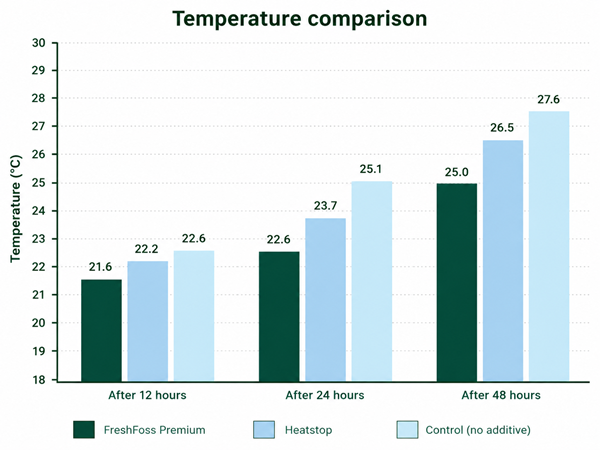
Under the conditions of the trial, FreshFoss Premium therefore delayed noticeable heating by more than eight hours compared with untreated feed.
Another important measurement was the the aerobic stability until the temperature increased by 2.5°C above its minimum. The untreated control reached this point after 20.1 hours. With FreshFoss Premium, it took 28.4 hours. This means that, in the conditions of the trial, FreshFoss Premium delayed the point at which the TMR began to heat noticeably by more than eight hours compared with untreated feed.
What does this mean for dairy farmers?
The results are especially relevant in situations where maintaining feed stability is a challenge. According to SEGES, a product that delays heating may be particularly relevant when:
- TMR remains on the feed table for a long time
- temperatures in the barn are high
- silage is already beginning to heat
- mould is observed in feed residues
- improved stability is needed during periods of high temperatures
Visible mould was also observed in some of the samples during the trial, further supporting the connection between heating and feed deterioration.
SEGES concludes that the addition of dry acid can improve the aerobic stability of TMR on the feed table and that FreshFoss Premium significantly reduced the rate of temperature increase compared with untreated feed.
When the ration stays stable, farmers have a better basis for preserving the quality of the feed they have already invested in producing.
Learn more about FreshFoss Premium.
Source: SEGES Innovation. Kviesgaard, H. & Fjordside, M. Stabilisering af TMR-fuldfoder på foderbordet. LandbrugsInfo, 2026.